Iran Blockade Update: US Jet Disables Chinese-Owned Ship as Washington's Secret Push to Break OPEC Leaks
A US aircraft fired on the Pacific Archer after it slipped out of Bandar Abbas, and Iran's navy chief vowed to "drive the enemy out." Hours earlier, Reuters revealed the Trump administration leaned on Venezuela and Iraq to quit OPEC. Oil jumped back toward $96, and Sunday's OPEC+ meeting decides what you pay next.
Add Zurnt as a preferred source on Google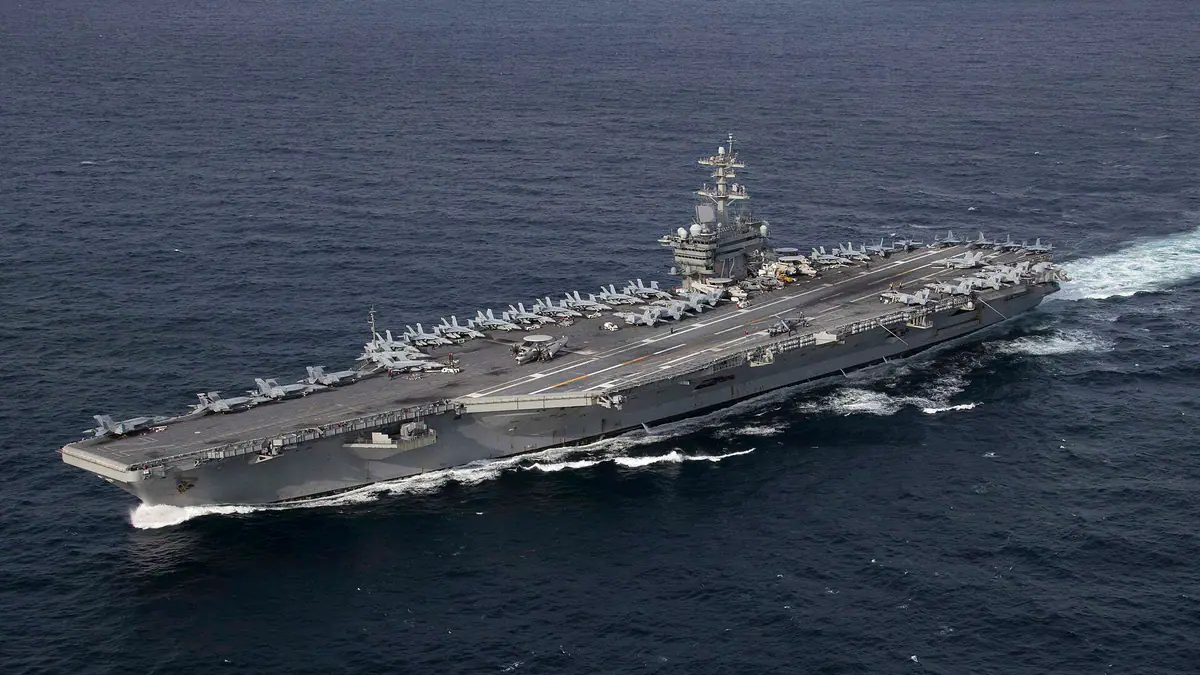
- A US military aircraft fired "precision munitions" into the stern of the Palau-flagged, Chinese-owned bulker Pacific Archer in the Gulf of Oman on Thursday, Nov. 26, after it left Iran's Bandar Abbas port. The crew was unharmed.
- It is at least the 15th ship the US has disclosed disabling since its blockade of Iranian ports began in April, and the sixth since the blockade resumed in July. Another 158 ships turned back.
- Reuters reported that Washington pushed Venezuela and Iraq, two of OPEC's five founders, to consider quitting the cartel, and blocked Caracas from paying its roughly $3 million membership dues.
- Brent crude for January delivery climbed to around $96 a barrel on Friday, ahead of a Sunday, Nov. 29 OPEC+ meeting where Iraq wants a bigger quota. US gasoline averages $3.55 a gallon.
The latest Iran blockade update came with a missile strike at sea and a leak from Washington, and both point straight at the price of a tank of gas.
US Central Command said Friday that one of its aircraft disabled the M/V Pacific Archer, a Palau-flagged merchant ship, in the Gulf of Oman on Thursday after the crew ignored repeated warnings and tried to run the American blockade of Iranian ports.
The aircraft fired "precision munitions" at the ship's stern, and "the ship's propulsion was ultimately disabled and the civilian crew was unharmed," CENTCOM said in a statement reported by the Associated Press.
The vessel had just left Bandar Abbas, Iran's main southern port, and ship-tracking sites listed its destination as Singapore, the AP reported. NDTV, Al Jazeera, Sky News and The Hill all carried the military's account.
Iran vows to break the blockade
Tehran answered with a threat. Shahram Irani, commander of the Iranian navy, said on state television that Iran would carry out operations "that will not only break the naval blockade but also drive the enemy out of the region's waters," the AP reported.
Iran's Revolutionary Guard added its own claim on Friday: two tankers had tried to cross the Strait of Hormuz through an "unauthorized" route, and one struck a naval mine while the other was forced back. That claim has not been independently confirmed.
Maritime Executive reported that Irani also repeated earlier Iranian claims that a missile had hit the aircraft carrier USS Abraham Lincoln, and told a story of commandos retaking two vessels seized by the US while American guards were "asleep." The US has not confirmed either account, and the outlet described the commandos story as fanciful.
The US keeps two aircraft carriers in the region at all times, along with a host of other warships, according to the AP.
The ship, the owners and the ones that got away
The Pacific Archer is a 52,400-ton bulk carrier built in 2001 that has sailed under its current identity since 2025, according to Maritime Executive, which identified its owners as Chinese.
The blockade is not airtight. Maritime intelligence firm Windward told Maritime Executive that a US-sanctioned product tanker, the Voyager Haven, appears to have slipped out of the Gulf of Oman and was heading toward Djibouti while falsely claiming a Mali flag. A second sanctioned tanker, the World Progress, stopped just short of the US line after apparently renaming itself Shen Zhou on its tracking signal.
CENTCOM urged all mariners in the Gulf of Oman and the approaches to Hormuz to "heed blockade warning."
How the blockade got here
The US-Israeli war on Iran began at the end of February and has since settled into what the AP describes as a quiet stalemate, punctuated by attacks on shipping and Gulf oil sites.
| Date | Event |
|---|---|
| Late February 2026 | US-Israeli war with Iran begins; Hormuz traffic collapses |
| April 2026 | US starts blockading Iranian ports |
| June 2026 | Strike on the Palau-flagged tanker M/T Settebello kills three Indian sailors, Indian officials say; the head of the UN's International Maritime Organization condemns it |
| Summer 2026 | Blockade lifted during talks with Tehran |
| July 2026 | Blockade resumes |
| October 2026 | Record 30 attacks on tankers in and near Hormuz, per CNN's analysis of UK Maritime Trade Operations data |
| Nov. 7, 2026 | Previous ship disabled by US forces |
| Nov. 26, 2026 | Pacific Archer disabled after leaving Bandar Abbas |
Since July, the military says it has redirected 158 merchant ships and disabled those that refused, the AP reported. CENTCOM has consistently said its forces issue multiple warnings before opening fire.
President Donald Trump has swung between threatening new large-scale strikes and insisting the war "militarily is effectively over," the AP reported. Earlier this month, officials in the region told the AP that Israeli Prime Minister Benjamin Netanyahu was pushing Washington to restart the war or let Israel strike Iran's nuclear and missile sites, while Gulf states, Pakistan and Turkey lobbied US officials to prevent a new round.
The region's violence spilled onto land again this week. A suspected Iranian drone attack on a Kuwaiti military site killed two Italian technicians, which Iran denied, and Yemen's Houthis struck Saudi Aramco's Jazan refinery a day after hitting Ras Tanura.
The secret push to break OPEC
On the same day, Reuters published an exclusive, citing 10 people familiar with the matter, that the Trump administration had pushed Venezuela and Iraq to consider leaving OPEC earlier this year. The Times of India and other outlets carried the report.
The goal, according to Reuters, was to stop OPEC's output limits from capping production in two countries where US oil companies are now pouring in money.
After the US removed Venezuelan President Nicolas Maduro in January, the State Department opened talks with Venezuelan officials about leaving the group, five people told Reuters. Washington controls Venezuela's access to state funds held in a US account, and it blocked Caracas from paying its annual OPEC dues of about 2.8 million euros ($3.08 million), according to the report.
The State Department did not directly answer questions about the dues. "The Department receives disbursement requests from the interim Venezuelan government and reviews the requests, including against a list of approved and prohibited uses of the foreign Government Deposit Funds," an official told Reuters. The official said lower-level staff may have raised an OPEC exit, but "it has not been among the issues raised by high-level officials."
The pressure on Caracas was strong enough that Saudi Crown Prince Mohammed bin Salman stepped in this summer and persuaded the administration to drop it, two people told Reuters. Two OPEC sources said the group does not plan to expel Venezuela over the unpaid dues.
In Iraq, Prime Minister Ali Faleh al-Zaidi raised the idea of leaving at a government meeting this summer after talks with US officials who encouraged it, Reuters reported. His oil ministry talked him out of it and suggested Baghdad fight for a higher quota instead.
The State Department said its talks with Iraq focused on energy infrastructure and raising production and exports, not OPEC membership.
"The risk of OPEC fracture is rising," Dan Alamariu, chief geopolitical strategist at Alpine Macro, told Reuters.
Iraq's quota fight lands on Sunday
That fight now reaches the table. Reuters reported on Friday that Iraq's oil minister said Baghdad is in talks with OPEC for a higher oil quota before the OPEC+ meeting on Sunday, Nov. 29.
Iraq has a lot to win back. The country pumped just 1.48 million barrels a day in May, down from almost 4.2 million in February before Hormuz effectively closed, Reuters reported this summer, citing OPEC data. Oil made up 88% of Iraqi government revenue last year, according to World Bank figures cited by Reuters, against about 55% for Saudi Arabia.
The International Energy Agency has said Iraq can produce 4.9 million barrels a day, well above its July quota of 4.378 million. BP has committed up to $25 billion to fields in Kirkuk, TotalEnergies is running a $10 billion project in Basra, and ExxonMobil has signed for the giant Majnoon field, Reuters reported.
Washington is backing al-Zaidi on another front too. Trump said in a Truth Social post on Friday that the US supports his drive to "stop the smuggling of Iraqi oil, end corruption, and bring all weapons under the exclusive control of the state," Al Jazeera reported. Baghdad has moved to take over border crossings and oil fields in the Kurdish region, which says its constitutional rights are being violated. A meeting to defuse the standoff is set for Dec. 1 in Baghdad.
OPEC is already shrinking. It has lost four members since 2019: Qatar, Ecuador, Angola and, earlier this year, the United Arab Emirates, which left frustrated by output limits. Reuters said there is no indication the US was involved in those exits. The group now has 11 members.
What it means for your gas bill
Oil had been sliding for weeks. This week it turned.
Front-month Brent for January delivery traded around $96 a barrel on Friday, on track for its first weekly gain of November and up about 3.5% for the week, CNN reported. It had dipped below $90 earlier in the week. US benchmark West Texas Intermediate traded near $84.50. During the war, Brent touched nearly $120 at times.
"These attacks remind us of the inherent instability of the status quo, as a lasting peace deal between the US and Iran remains elusive," Kathleen Brooks, research director at broker XTB, wrote in a note cited by CNN.
The flows explain why. Oil moving through Hormuz ran at 55% of its prewar level in the week to Nov. 25, according to preliminary Kpler data cited by CNN. Rystad Energy said flows in the first two weeks of November fell about 20% from October, to around 13 million barrels a day, against a prewar 15 to 16 million, the AP reported.
At the pump, drivers have had a break, but it may be ending.
| Measure | Price |
|---|---|
| US regular gasoline, national average (Nov. 27) | $3.548 a gallon |
| A week earlier | $3.690 |
| A month earlier | $4.266 |
| A year earlier | $3.026 |
| US diesel, national average (Nov. 27) | $5.705 a gallon |
| Brent, January contract (Nov. 27, approx.) | $96 a barrel |
| WTI (Nov. 27, approx.) | $84.50 a barrel |
Sources: AAA for fuel prices, CNN for crude.
Regular gasoline is about 72 cents a gallon cheaper than a month ago, AAA data shows, but still about 52 cents above a year ago. On a 15-gallon fill-up, that is roughly $7.80 more than last Thanksgiving, by Zurnt's calculation. Diesel, which moves the trucks that stock store shelves, is up about $1.94 a gallon on the year. That pressure feeds into the higher holiday prices shoppers are already paying.
The Washington strategy cuts two ways for drivers. If Venezuela and Iraq pump more, outside OPEC's limits or with bigger quotas, more crude hits the market and prices should ease over time. If the push splinters OPEC, the group loses its ability to manage supply, which could make prices swing harder in both directions.
What happens next
OPEC+ meets Sunday, Nov. 29. The group has held output steady since September after six straight increases. ING analysts expect it to "consider keeping current production quotas unchanged through January, although some members have been pushing for higher quotas," CNN reported. Iraq is the loudest of those members.
A quota hike for Iraq would be read as a win for Baghdad and, indirectly, for Washington. A refusal could revive talk inside Iraq's ruling coalition, where some factions see OPEC as dominated by Saudi Arabia and Russia, of leaving altogether, Reuters reported.
At sea, the next test is whether Iran follows through on its navy chief's threat, and whether more tankers try to slip the blockade the way Windward says the Voyager Haven did. Traders have been watching the $100 line on Brent, which the January contract has not crossed this month.
In Iraq, the Dec. 1 meeting between Baghdad and Kurdish leaders decides whether the oil-smuggling crackdown turns into a deeper political crisis.
Zurnt will update this story after the OPEC+ decision.
Read next
 World
Two Italians Killed in Kuwait Drone Attack; Iran Denies Role
 Markets
Oil Prices Today: WTI Sinks to $85 as Middle East Exports Come Back
 World
Kenneth Law Sentence: Crown Wants 25 Years for 'Poison Seller' Tied to 93 Deaths, and He Finally Says Sorry
 BreakingWorld