Gukesh vs Sindarov Game 5: Four Draws In, Sindarov Has White Again in Geneva
The world title match is locked at 2-2 after four draws and 148 moves of trench warfare. Javokhir Sindarov gets the white pieces again on Sunday, and D Gukesh says the match feels nothing like Singapore.
Add Zurnt as a preferred source on Google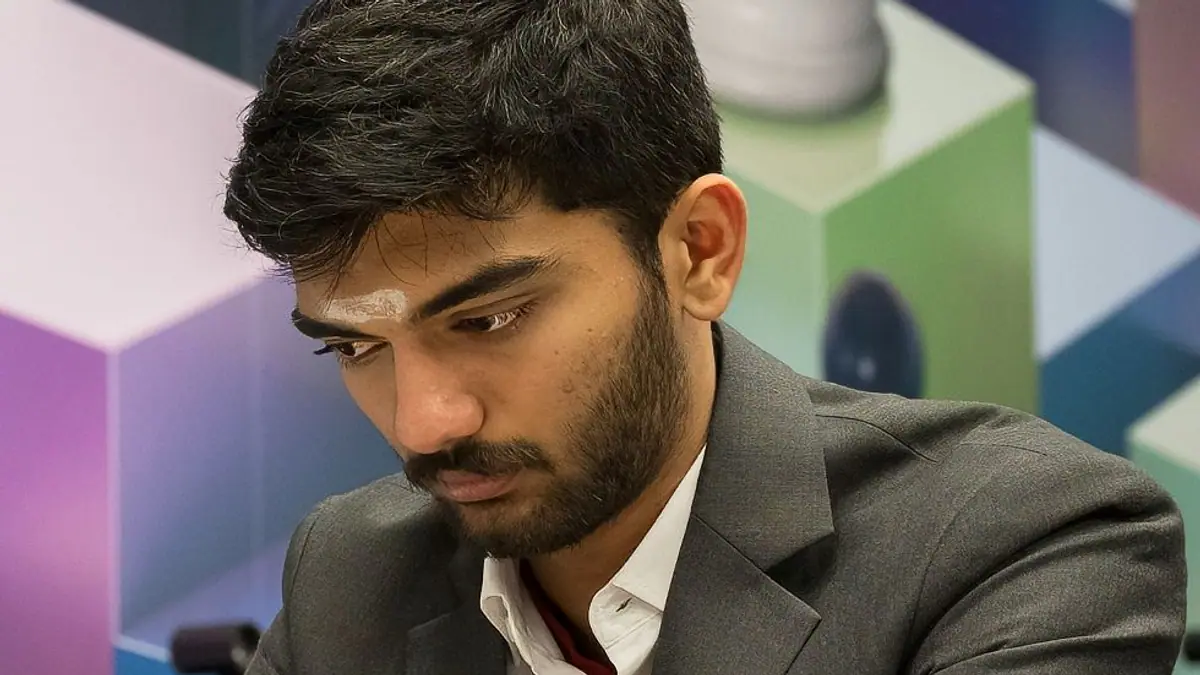
- The FIDE World Chess Championship between D Gukesh and Javokhir Sindarov is tied 2-2 after four straight draws in Geneva.
- Game 5 began at 7:30 p.m. IST on Sunday, Nov. 29, with challenger Sindarov holding the white pieces.
- The first player to 7.5 points out of 14 takes the title and a share of a $2.5 million prize fund.
- Gukesh's surprise 9.Qb1 in Game 4 was "too beautiful" not to play, he said, but it still only produced a 34-move repetition.
Gukesh vs Sindarov resumed on Sunday with nothing separating the two 20-year-olds. Four games, four draws, and a score of 2-2 at the Fondation Martin Bodmer in Cologny, on the edge of Geneva.
Game 5 started at 3 p.m. local time (7:30 p.m. IST), and Uzbekistan's Sindarov has white. Under the match rules he gets white in every odd-numbered game, so this is his third turn with the first move.
Nobody has cracked yet. The first four games ran 148 moves between them, and the longest, Game 3, went 60 moves before dying in an opposite-coloured bishop ending.
The Qb1 shock that did not land
The match came closest to catching fire on Saturday. With white in Game 4, Gukesh walked into a Petroff Defence and chose 5.Be2, a line ChessBase India counted in only 26 games in its Mega Database.
Sindarov thought for about 18 minutes before answering 5...Nc6. Then Gukesh played 9.Qb1, a quiet queen move he made in roughly seven seconds, a sign it came straight from home preparation.
"This 9. Qb1 idea, obviously, you don't play without prep. It was just too beautiful," Gukesh said at the press conference afterward, according to ChessBase India's transcript.
Sindarov was not rattled. "It doesn't take a lot of time to understand the idea, 9. Qb1," he said. He called his reply, 9...Nxc3, "probably the only move".
The game ended after 34 moves by threefold repetition, with queens and four pawns each left on the board and Gukesh giving checks that Sindarov could not escape.
"But in general, I think my position is super solid. It's hard to beat," Sindarov said.
Game by game
| Game | Date | White | Opening | Moves | Result |
|---|---|---|---|---|---|
| 1 | Nov 24 | Sindarov | Berlin Defence | n/a | Draw |
| 2 | Nov 25 | Gukesh | London System | 20 | Draw by repetition |
| 3 | Nov 26 | Sindarov | Ruy Lopez, Berlin-type line | 60 | Draw |
| 4 | Nov 28 | Gukesh | Petroff Defence | 34 | Draw by repetition |
| 5 | Nov 29 | Sindarov | In progress |
Game 2 was the shortest and the most uncomfortable for the champion. Gukesh opened with the London System, sank about 30 minutes into 16.f3 and fell roughly 40 minutes behind on the clock before the game ended in a 20-move repetition, according to ChessBase India.
Game 3 turned the other way. Gukesh built a big time lead by move 15, and Sindarov later said his 29.f4 "was probably the critical moment". Gukesh said he "found a very clean way to keep it under control".
Two very different matches
Gukesh has been here before. In December 2024 in Singapore he beat China's Ding Liren 7.5-6.5 to become the youngest undisputed world champion in history, at 18. That match was also level after its opening stretch.
He insists the resemblance ends at the scoreboard. "I think both matches are going very differently, even though the score is the same so far," he said on Saturday.
Sindarov arrived in Geneva with momentum. He won the 2026 Candidates Tournament in April unbeaten on 10 out of 14, sealing first place with a round to spare, according to Chess.com. He turns 21 on Dec. 8, in the middle of the match.
Neither player is talking like the match is close to being decided. "I think it's still pretty early to think about the whole match in the bigger picture," Gukesh said.
"It's only four games; there are 10 more games, and everything can happen," Sindarov said. He also brushed off questions about meeting the Petroff with white later in the match: "But I'm an e4 player, I played e4 all my life."
The rules that could decide it
The match is scheduled for up to 14 classical games, played in blocks of three followed by a rest day. It ends early if either player reaches 7.5 points, so the final games may never be played.
The time control is 120 minutes for the first 40 moves, then 30 more minutes, with 30 seconds added per move from move 41. Players cannot agree a draw before Black's 40th move; before that, a game can only be drawn by threefold repetition or stalemate, claimed through the arbiter.
Both repetition draws in this match came through that route.
If the score is 7-7 after Game 14, scheduled for Dec. 11, the title goes to tiebreaks on Dec. 12:
| Stage | Format |
|---|---|
| 1 | Four rapid games, 15 minutes + 10 seconds per move |
| 2 | Two games, 10 minutes + 5 seconds |
| 3 | Two blitz games, 3 minutes + 2 seconds |
| 4 | Single 3+2 games, colours reversed, until someone wins |
The prize fund is $2.5 million, with Salesforce as title sponsor, according to ChessBase India.
What happens next
Game 6 follows on Monday, Nov. 30, with Gukesh back on white, before the match reaches its next rest day.
Whoever wins the first decisive game takes a lead that has become rare at this level. In Singapore, Gukesh went behind in Game 1 and still won the title in Game 14, so neither camp will treat one result as the end.
Indian fans are splitting their evenings between Geneva and the cricket, where India trail New Zealand heavily in the 2nd Test and where Rohit Sharma's return as Mumbai Indians captain is still the talk of the IPL off-season. The chess board has been kinder to India so far: four games, no losses for its champion.
A Sindarov win would send the classical world title to Uzbekistan for the first time. That is the pressure Gukesh carries into every game with black.
This story will be updated with the Game 5 result.
Read next
 Sports
Steve Evans Out at Bristol Rovers After Tranmere Rout, With Ashley Cole in the Frame
 Sports
James Botham Tackle Record: 39 Hits, a Week After Wales Dropped Him
 Sports
The Rock at Survivor Series: He Leaves His Sunglasses and Mic in the Ring, and Fans Ask if It's Goodbye
 Sports